Showing posts with label Snakes. Show all posts

Saturday, November 26, 2011

Black Mamba


The Black Mamba is species of venomous snakes that were given the scientific name Dendroaspis polylepis. They are one of Africa’s most dangerous snakes and one the largest venomous snake in the world, growing up to about 12-14ft. It can be found all throughout Africa and inhabits a wide variety of areas. They are very aggressive when threatened, striking with deadly accuracy and will not hesitate to do so.

Though its name is the Black mamba it is not always “black”. When young it tends to be more of a grayish green color, but as it gets older the skin on the snake will darken.
The Black Mamba is the largest poisonous snake in all of Africa, it is also the second longest poisonous snake in the world. As adults, black mambas on average grow to be about 2.5 meters in length and a maximum of about 4.5 meters which is about 14ft. Like all of the other reptiles, the black mamba relies heavily on external heat to control the temperature of its body. Out of all the venomous snakes in the world there is only one snake that is longer, that snake is the King Cobra.

The snake's color isn't actually black. Usually the black mambas that are seen have more of a brown color to them, although some have a dark olive, olive green, grey brown, or metallic looking color. Some of the snakes have a light ring or band around their body. As the mambas get older, their skin begins to get darker.

The black mamba is known to be the fastest moving snake in the world, and has been claimed to move at up to 12mph. There are four different ways that a snake can move. There is the concertina method, the serpentine method sidewinding, and also the rectilinear method. The black mamba uses more of a serpentine method of moving itself.

The King Cobra


king cobra

Thursday, November 10, 2011

Anaconda


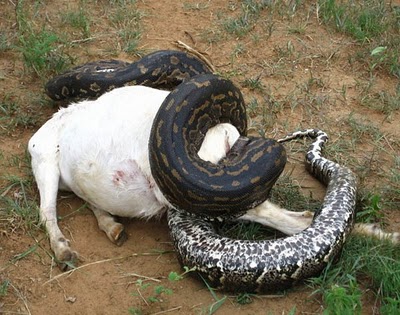
Anaconda is a large, non-venomous snake found in tropical South America. Although the name actually applies to a group of snakes, it is often used to refer only to one species in particular, the common or green anaconda, Eunectes murinus, which is one of the largest snakes in the world.

Wednesday, November 2, 2011

Snakes


Snakes are elongate, legless, carnivorous reptiles of the suborder Serpentes that can be distinguished from legless lizards by their lack of eyelids and external ears. Like all squamates, snakes are ectothermic, amniote vertebrates covered in overlapping scales. Many species of snakes have skulls with many more joints than their lizard ancestors, enabling them to swallow prey much larger than their heads with their highly mobile jaws. To accommodate their narrow bodies, snakes' paired organs (such as kidneys) appear one in front of the other instead of side by side, and most have only one functional lung. Some species retain a pelvic girdle with a pair of vestigial claws on either side of the cloaca.

Living snakes are found on every continent except Antarctica and on most islands. Fifteen families are currently recognized, comprising 456 genera and over 2,900 species. They range in size from the tiny, 10 cm-long thread snake to pythons and anacondas of up to 7.6 meters (25 ft) in length. The fossil species Titanoboa cerrejonensis was 15 meters (49 ft) long. Snakes are thought to have evolved from either burrowing or aquatic lizards during the mid-Cretaceous period, and the earliest known fossils date to around 112 Ma ago. The diversity of modern snakes appeared during the Paleocene period (c 66 to 56 Ma ago).

Most species are nonvenomous and those that have venom use it primarily to kill and subdue prey rather than for self-defense. Some possess venom potent enough to cause painful injury or death to humans. Nonvenomous snakes either swallow prey alive or kill by constriction.